Peer Review Process
Initial evaluation:
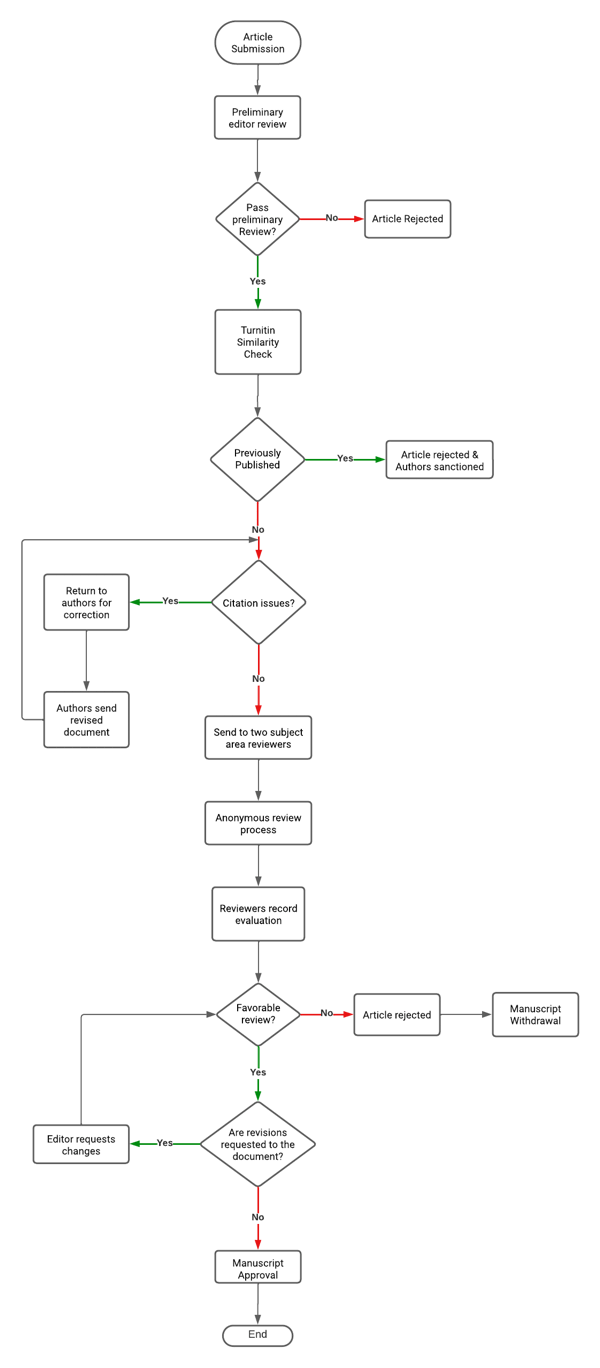
Manuscripts submitted by authors undergo a preliminary review conducted by the Editor, in accordance with the journal’s editorial policy and the requirements established in the guidelines for authors
Document similarity verification is carried out using Turnitin Similarity Check software.

If the Turnitin Similarity Check software report determines that the document does not present significant similarities, the editor will assign at least two external and independent reviewers with expertise in the manuscript's field of knowledge.
Articles that do not meet these criteria may be rejected directly, without proceeding to the next peer review stage.
Double-Blind Peer Review
Revista Científica del Amazonas applies a double-blind peer review process, meaning that both reviewers and authors remain anonymous in order to reduce bias and ensure impartiality. The Editor ensures that reviewers are not affiliated with the same institution as the authors.
Reviewers evaluate the manuscript in terms of originality, methodological rigor, relevance, and contribution to the field of study. The reviewer records the evaluation using the assessment form provided by the journal [See format].
The peer review process has a minimum duration of five weeks, during which reviewers analyze the manuscript according to the journal’s evaluation criteria.
Once the evaluation process is completed, the reviewer submits a formal report to the Editor. The editorial decision may be:
a) Accepted without revisions.
b) Accepted with minor revisions (no further review required).
c) Accepted with major revisions (subject to a new round of review).
d) Rejected (not suitable for publication in the journal).
Conflict of interest:
Authors, reviewers, and editors must disclose any potential conflicts of interest that could influence the manuscript evaluation process. A conflict of interest is defined as any financial, professional, personal, or institutional relationship that may affect the impartiality of the evaluation.
Reviewers must refrain from evaluating manuscripts in which they have any conflict of interest with the authors or their affiliated institutions. Similarly, authors must disclose whether their research has been funded by any entity that could influence the interpretation of the results.
If an undeclared conflict of interest is identified at any stage of the editorial process, the manuscript may be withdrawn from the evaluation process.
Incorporation of Comments and Revisions
Following peer review, the editorial team will compile and incorporate the reviewers’ comments into the original document and forward them to the authors for the requested revisions, if applicable.
Revisions may be required in sections such as the title, keywords, abstract, introduction, literature review or theoretical framework, methodology, results, discussion, conclusions, and the presentation of citations and references.
Verification of Corrections
Once the authors have completed the required revisions, reviewers will reassess the manuscript to verify that the recommended improvements have been properly implemented. Reviewers will have four weeks to evaluate the revised submission.
Only manuscripts that satisfactorily comply with all recommendations and editorial requirements will be accepted for publication.
If a manuscript is rejected, it will be withdrawn from the evaluation process and may not be resubmitted to the journal.
Evaluation Process